For horses · Dec 21, 2012
Your mare’s moody season behaviour comes down to biochemistry, here’s what helps
The hormonal swings behind your mare’s cycle-linked aggression, soreness, and moodiness are well understood, and there are targeted natural compounds that work with her chemistry rather than against it.
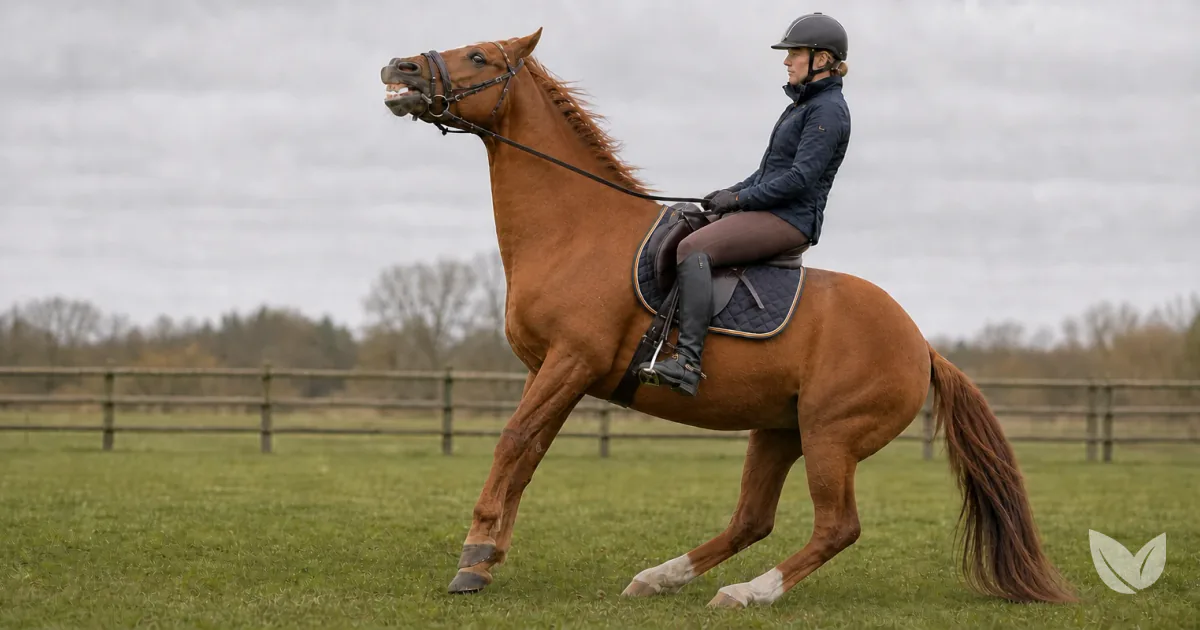
If your mare turns into a different horse every few weeks, here’s what’s actually going on: her behaviour is being driven by fluctuating hormones, not a bad attitude. The average mare cycles every 21 days, spending 2-8 days in oestrus; the aggression, kicking, and reluctance under saddle tend to peak during diestrus, when progesterone dominates and receptivity drops sharply. Natural support combining Vitex agnus-castus (chaste tree), magnesium, vitamin B6, and Boswellia serrata targets the hormonal and inflammatory drivers directly.
Common misconception: Mares behave badly during oestrus
I hear this one all the time, and honestly, I get it, if your mare is bucking, biting, or completely ignoring your aids, it’s tempting to point the finger straight at oestrus. She’s visibly hormonal, she’s interested in the stallion down the road, so surely that’s what’s driving the chaos? It’s a logical conclusion. It’s also, in most cases, wrong.
The research tells a rather different story. During oestrus itself, mares actually show *better* behaviour towards both humans and other horses, and they’re less locomotively active than at other points in their cycle [2]. The difficult stuff, the aggression, the squealing, the kicking, is far more characteristic of diestrus, the phase immediately *after* ovulation, when progesterone rises and oestrogen falls [2, 11]. Behavioural changes towards humans and herd-mates appear right at the start of diestrus, not during oestrus, and the timing tracks closely with those shifting hormone levels [2].
So why does the misidentification matter? Because if you’re managing your mare on the assumption she’s difficult “because she’s in season,” you’re pointing your efforts at entirely the wrong phase of the cycle. And you might be missing something else altogether, it’s well established that unwanted behaviour can stem from medical conditions causing pain, ovarian disorders, or other sources that have nothing to do with her cycle at all [3].
Here’s the honest picture: oestrus-associated behaviour is real and can absolutely be disruptive, the receptive displays, the distraction, the physical tenderness, but the genuinely dangerous behaviour that worries most owners is more often a diestrus problem, driven by the progesterone-dominant phase. Getting that distinction right is where sensible management, and sensible supplementation, actually has to begin.
How the ingredients work: the biochemistry behind the blend
The hormonal driver of difficult behaviour
So, here’s what’s actually going on. Your mare’s 21-day cycle splits into two phases: estrus (roughly 7 days when she’s “in season”) and diestrus (the non-receptive phase). The behavioural changes you’re seeing track directly with her hormone levels, sexual receptivity, and all the mood shifts that come with it, only kick in once circulating progesterone drops below 2 ng/mL while estradiol rises from the developing follicle. Then, once the cycle swings into diestrus and progesterone from the corpus luteum climbs back up, *that’s* what drives the squealing, kicking, and biting that many owners find just as exhausting to deal with. Research confirms that the behavioural changes towards humans and other horses actually appear at the *beginning* of diestrus, not only during estrus itself, which ties the problem firmly to the hormonal swing rather than to any single phase of the cycle. [1, 2, 11, 25]
Vitex agnus-castus (chaste tree berry), dopaminergic prolactin suppression
This is one of my favourite herbs, and the biochemistry behind it is genuinely fascinating. Vitex agnus-castus contains diterpenes (including clerodadienols), flavonoids, and iridoids that act on the pituitary gland via dopamine D2 receptors. Binding to those receptors suppresses the release of prolactin. Elevated prolactin is implicated in cyclic breast pain, irregular cycles, and related reproductive symptoms, and at higher doses, this prolactin-lowering effect is well documented. The plant also engages opioidergic and indirect serotonergic pathways, which is where its mood-stabilising profile comes from. Systematic review data show it normalises luteal-phase progesterone and estradiol, and reduces cyclic breast pain and irritability. That’s a lot of work from one plant. [5, 19, 21, 30, 31, 49]
5-HTP, direct serotonin precursor
Here’s a connection that doesn’t get nearly enough attention. Oestrogen fluctuations across the cycle directly modulate tryptophan hydroxylase-2 (TPH2), the rate-limiting enzyme for serotonin synthesis in the dorsal raphe nucleus. When oestrogen falls in the luteal phase, serotonin synthesis capacity falls with it, and that’s one clear biochemical reason why mood and anxiety symptoms tie so neatly to the cycle. 5-Hydroxytryptophan (5-HTP) bypasses the rate-limiting tryptophan hydroxylase step entirely, crosses the blood-brain barrier at around 70% absorption, and raises central serotonin directly. It’s a more direct route than L-tryptophan for this specific purpose. [33, 36, 50]
Boswellia serrata, 5-LOX and COX inhibition
I include Boswellia because cycle-related discomfort isn’t just about mood, it’s also about inflammation and pain, and those things matter for a horse in work. The gum resin of Boswellia serrata contains boswellic acids, most notably acetyl-11-keto-boswellic acid (AKBA), which are specific, non-redox inhibitors of 5-lipoxygenase (5-LOX), the enzyme that drives leukotriene biosynthesis. Block that, and you significantly reduce leukotriene B4, prostaglandin E2, and TNF-α: the key mediators of inflammatory pain. Boswellia also inhibits COX-2. And critically for horses specifically, a placebo-controlled study in show-jumping horses supplemented with Boswellia serrata showed significant downregulation of interleukin-1α, interleukin-6, and toll-like receptor 4 expression. That’s real equine data, not a straight extrapolation from human trials. [7, 14, 35, 41, 42]
Calcium, magnesium, and vitamin B6, a synergistic triad
These three don’t get the credit they deserve, probably because they seem unremarkable compared to the botanicals. But the evidence is solid. Calcium at supplemental doses consistently reduces premenstrual depression, fatigue, oedema, and pain in controlled trials, it has the strongest evidence base of any dietary supplement for cycle-related symptoms, full stop. Magnesium combined with vitamin B6 (pyridoxine) reduces psychological symptoms (mood, anxiety) and physical symptoms (cramping, water retention) more effectively than either alone, and the combination approach shows more consistent benefits across symptom clusters than single-nutrient supplementation. There’s also an interesting mechanistic clue from buffalo research: salivary calcium and magnesium concentrations are positively correlated with oestrogen and negatively correlated with progesterone across the cycle, which suggests these minerals fluctuate with cycle phase, and that restoring them may help buffer the hormonal swing. [8, 9, 17, 28, 29, 43, 44]
One thing I always flag with magnesium: excess intake can trigger signs of calcium deficiency. That’s exactly why the ratio between the two matters, and why I use both together rather than magnesium on its own. [45]
What we’d recommend
Supports your mare through her season with natural botanicals and targeted nutrients that tackle soreness, hormonal imbalance, and mood swings.
See the product
Frequently asked questions
Why does my mare behave so differently depending on where she is in her cycle?
Honestly, it comes down to her hormones, and once you understand that, so much of her behaviour makes sense. When oestradiol is rising and progesterone is low, she’s typically calmer and more cooperative. The moment she tips into dioestrus, progesterone climbs and that’s when the aggression, kicking, and biting show up, research confirms these behavioural shifts track closely with the hormonal changes. It’s not attitude. It’s endocrinology, plain and simple.
How long does a mare’s oestrous cycle last, and how long is she actually ‘in season’?
The average cycle runs 21 days in total. The receptive part, oestrus proper, typically lasts anywhere from 2 to 8 days, during which she’ll raise her tail, squat, urinate, and actively seek a stallion. Everything else is dioestrus, when that same mare will squeal, kick, and flatly reject any advances. Once you know this rhythm, you can anticipate what’s coming rather than just reacting to it each time.
Can chaste tree berry (Vitex agnus-castus) actually help with hormonal cycle problems?
I think it absolutely can, and the evidence backs that up. Vitex agnus-castus works through dopaminergic, phytoestrogenic, and serotonergic pathways, it’s genuinely influencing prolactin regulation and hormonal balance, not just sitting in the body doing nothing. In a retrospective cohort of 1,700 women, three months of treatment brought irregular cycles down from 9.1% to 0.1% and breast tenderness from 39.9% to 0.8%. The mechanism is real, and the evidence base is substantial.
Why use Boswellia serrata for cycle-related soreness in mares?
Because it’s one of the most targeted natural anti-inflammatories we have available. The boswellic acids in Boswellia serrata resin selectively inhibit 5-lipoxygenase (5-LOX), which blocks leukotriene B4 and prostaglandin E2, two of the key inflammatory mediators behind cycle-related pain and tissue discomfort. Standardised extracts have demonstrated both meaningful pain relief and tissue protection in validated models. That’s a specific, well-characterised mechanism, not just a vague ‘anti-inflammatory herb’ claim.
Do calcium, magnesium, and vitamin B6 really make a difference to cycle-related mood and discomfort?
They really do, and I’d say the evidence here is stronger than most people expect. Calcium at 1,200 mg/day significantly reduced premenstrual depression, fatigue, oedema, and pain in a double-blind RCT, it carries the best quality evidence of any supplement in this space. Magnesium combined with vitamin B6 shows synergistic effects on anxiety-related symptoms, and a combined Vitex, B6, and magnesium formula produced measurable reductions in overall symptom severity in a real-world study. These aren’t weak associations; they’re consistent findings across multiple trials.
Are conventional hormone treatments like altrenogest a better option than natural approaches?
That really depends on what you’re dealing with. Altrenogest and progesterone-in-oil are used to suppress oestrus behaviour in performance mares, but the Merck Veterinary Manual notes they may not effectively suppress follicle growth and ovulation in cycling mares. Laparoscopic ovariectomy does resolve oestrus-associated behaviour, but it’s irreversible surgery, full stop. Natural approaches target the same hormonal and inflammatory pathways without those trade-offs, which is why I find them worth exploring first. That said, if there’s an underlying medical condition driving the behaviour, that needs proper veterinary investigation before anything else.
Sources
- The Reproductive Cycle of Horses – Management and Nutrition – Merck Veterinary Manual
- Variation of Physiological and Behavioural Parameters during the Oestrous Cycle in Mares
- Suppression of reproductive behaviour and gonadal function in female horses—An update
- Hormonal Control of Estrus in Horses – Management and Nutrition – Merck Veterinary Manual
- Vitex agnus-castus in Menopause: Phytochemistry, Mechanistic Insights, Clinical Applications, and Safety Perspectives
- Use of Vitex agnus-castus in patients with menstrual cycle disorders: a single-center retrospective longitudinal cohort study
- An Anti-Inflammatory Composition of Boswellia serrata Resin Extracts Alleviates Pain and Protects Cartilage in Monoiodoacetate-Induced Osteoarthritis in Rats
- Effect of calcium on premenstrual syndrome: A double-blind randomized clinical trial
- Efficacy and Tolerability Evaluation of a Nutraceutical Composition Containing Vitex agnus-castus Extract (EVX40™), Pyridoxine, and Magnesium in Premenstrual Syndrome
- Effect of Aromatherapy on Equine Heart Rate Variability
- The Effect of Treatment with Oestradiol Benzoate on Oestrus Expression and Endometrial Oedema in Anovulatory and Cyclic Mares
- Dietary intake with supplementation of vitamin D, vitamin B6, and magnesium on depressive symptoms: a public health perspective
- Effectiveness of Boswellia and Boswellia extract for osteoarthritis patients: a systematic review and meta-analysis
- Effect of Combined Use of Calcium and Vitamin B6 on Premenstrual Syndrome Symptoms: a Randomized Clinical Trial
- Treatment for the premenstrual syndrome with agnus castus fruit extract: prospective, randomised, placebo controlled study
- Vitex agnus-castus in Menopause: Phytochemistry, Mechanistic Insights, Clinical Applications, and Safety Perspectives
- Variation of Physiological and Behavioural Parameters during the Oestrous Cycle in Mares – PMC
- Evaluating the effect of magnesium and magnesium plus vitamin B6 supplement on the severity of premenstrual syndrome – PMC
- Effect of Combined Use of Calcium and Vitamin B6 on Premenstrual Syndrome Symptoms: a Randomized Clinical Trial – PMC
- Vitex agnus-castus extracts for female reproductive disorders: a systematic review of clinical trials – Database of Abstracts of Reviews of Effects (DARE): Quality-assessed Reviews – NCBI Bookshelf
- Chaste tree (Vitex agnus-castus)–pharmacology and clinical indications – PubMed
- 5-Hydroxytryptophan: a clinically-effective serotonin precursor – PubMed
- Effectiveness of Boswellia and Boswellia extract for osteoarthritis patients: a systematic review and meta-analysis – PMC
- Benefits of Hormone Therapy Estrogens Depend on Estrogen Type: 17β-Estradiol and Conjugated Equine Estrogens Have Differential Effects on Cognitive, Anxiety-Like, and Depressive-Like Behaviors and Increase Tryptophan Hydroxylase-2 mRNA Levels in Dorsal Raphe Nucleus Subregions
- Ethnoveterinary medicines used for horses in Trinidad and in British Columbia, Canada – PMC
- An Anti-Inflammatory Composition of Boswellia serrata Resin Extracts Alleviates Pain and Protects Cartilage in Monoiodoacetate-Induced Osteoarthritis in Rats
- Dietary Supplementation with Boswellia serrata, Verbascum thapsus, and Curcuma longa in Show Jumping Horses: Effects on Serum Proteome, Antioxidant Status, and Anti-Inflammatory Gene Expression
- Beneficial Role of Calcium in Premenstrual Syndrome: A Systematic Review of Current Literature – PMC
- Evaluation of salivary electrolytes during estrous cycle in Murrah buffaloes with reference to estrus detection
- Nutritional Diseases of Horses and Other Equids – Management and Nutrition – Merck Veterinary Manual
- Chaste tree (Vitex agnus-castus)–pharmacology and clinical indications – PubMed
- 5-Hydroxytryptophan: a clinically-effective serotonin precursor – PubMed