For horses · Aug 15, 2025
Most stabled horses are missing three vitamins, and owners don’t know it
Keeping horses stabled and hay-fed, away from fresh pasture, quietly drains their levels of vitamins A, D, and E faster than most owners would ever guess.
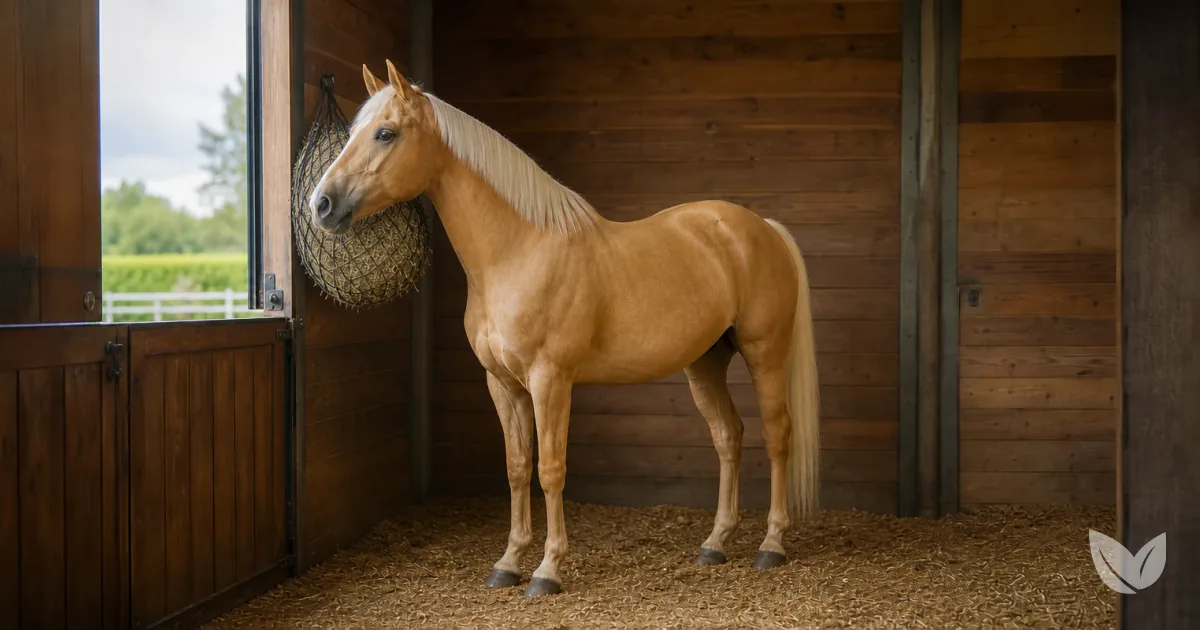
If your horse lives in a stable and doesn’t graze fresh grass, the chances are he’s running low on vitamins A, D, and E, and it happens faster than most people realise. Hay loses its vitamin A within a year of storage, and horses can become noticeably depleted within just two months off pasture. Horses also can’t make vitamin D from sunshine, they have to get it from their food. As for vitamin E, over a third of pasture-restricted horses show low levels even when they’re already being supplemented. Left unchecked, long-term deficiency is a known risk factor for equine motor neuron disease.
Why stabled horses run short of fat-soluble vitamins, and what that means in practice
Vitamin A gets into horses almost entirely through beta-carotene in fresh grass, the horse converts it as he eats. The snag is that beta-carotene breaks down during hay storage, so hay that’s been sitting in the barn for more than a year may deliver very little of it. A horse’s liver can hold a useful reserve: if he’s had good grazing for three to four months, that store can keep his vitamin A levels ticking along for another three to six months without fresh grass. But that reserve empties faster than most owners realise. Researchers found measurable depletion in horses fed only hay and concentrate within just two months, and within eight months even in horses with some pasture access.
Vitamin E tells a similar story, but with one important difference: there’s no meaningful liver reserve to draw on. The active form, alpha-tocopherol, breaks down quickly in stored hay and bagged feeds alike. Horses out on fresh pasture have noticeably higher levels in their blood than horses kept on stored feeds, and studies found that over a third (35.5%) of pasture-restricted horses tested below optimal even when they were being supplemented. The consequences matter: in one study, horses kept in without pasture and fed a vitamin E-deficient diet developed signs of equine motor neuron disease (EMND) after 21 months. The horses with pasture access stayed healthy.
Vitamin D is where horses really catch people off guard. Unlike humans, horses cannot make vitamin D3 from sunshine, researchers irradiated equine skin under ultraviolet light and found vitamin D3 was simply undetectable. Horses get their vitamin D from grazing fresh forage, in the form of vitamin D2 (ergocalciferol), and it’s 25-hydroxyvitamin D2, the dietary form, that shows up as the main circulating form in horses that aren’t supplemented. Take away the pasture, and that dietary source goes with it. Stabled horses that aren’t grazing have been shown to have significantly lower vitamin D levels in their blood, and they need dietary vitamin D3 supplementation to make up the shortfall.
How to support fat-soluble vitamin status in stabled or hay-fed horses
Who actually needs to supplement
Not every horse needs vitamin supplements, and I think it’s worth being clear about that. If your horse has good access to decent pasture, fresh grass is doing the job for vitamins A and E. Three to four months of grazing can keep vitamin A levels topped up for another three to six months after the grass runs out, thanks to the liver storing reserves [11].
But pull pasture out of the picture, and things change quickly.
Horses without fresh grazing start showing measurable vitamin A depletion within just two months [2]. More than a third of pasture-restricted horses, 35.5%, are short on vitamin E even when their owners are already supplementing [6]. And hay that’s been sitting in the barn for over a year? It’s likely lost most of its beta-carotene, so it won’t be topping up vitamin A the way you might hope [1].
Stabled horses have another problem on top of all that: vitamin D. Here’s something most people don’t realise, horses can’t make vitamin D from sunlight, full stop [8]. They rely entirely on what they eat. Stabled racehorses have been shown to have significantly lower vitamin D levels than grazing horses, and they genuinely need dietary vitamin D3 to make up the shortfall [7].
Form matters, especially for vitamin E
Vitamin E is fragile. The natural form breaks down quickly in stored hay and bagged feed [5], so by the time your horse is eating it, much of the goodness may already be gone.
When you do supplement, the form you pick really counts. Water-dispersible natural vitamin E (look for RRR-alpha-tocopherol on the label) is five to six times better absorbed than the synthetic version (dl-alpha-tocopherol), and it can more than double serum levels within 12 hours to three days [10]. If your horse has a muscle condition or neurological issue, including early equine motor neuron disease (EMND), which researchers have reproduced in horses kept off pasture on a vitamin E-deficient diet for 21 months [9], a water-soluble natural form isn’t just preferable, it’s the right call. A standard synthetic powder won’t cut it [5].
Timing and duration
The research points to two distinct situations:
– Seasonal gap-filling: Vitamin A and E levels peak in grazing horses between May and August [3]. From late autumn through early spring, and any time your horse is off pasture, fat-soluble vitamin support makes sense. Don’t wait and see; measurable depletion can set in within two months of losing pasture access [2].
– Year-round for permanently stabled horses: Without any pasture, these horses have no reliable dietary route to vitamin D2, their main dietary form [8], and face ongoing shortfalls in both vitamin E and A. For these horses, supplementation isn’t a seasonal thing, it’s a permanent fixture.
What we’d recommend
Tops up vitamins A, D, and E for stabled horses who can’t get what they need from hay alone.
See the product
Frequently asked questions
Do stabled horses really need vitamin supplements if they eat hay?
Yes, and it happens faster than most owners realise. Studies show that horses kept on hay and concentrate with no pasture can show significant vitamin A depletion in as little as two months. Vitamin E fares no better: it breaks down quickly as hay is stored, and research found that 35.5% of pasture-restricted horses had low vitamin E levels even when they were being supplemented. Hay on its own simply cannot be relied upon to cover these vitamins.
Can horses get enough vitamin D from sunlight?
No, and this surprises a lot of people. Unlike us, horses cannot make vitamin D from sunshine. Research has confirmed that vitamin D3 is completely undetectable in horse skin even after UV exposure. They get their vitamin D almost entirely from what they eat, mainly fresh grass. Horses that are stabled or off pasture consistently show lower vitamin D levels in their blood and genuinely need it topped up through their diet.
How quickly do vitamin A levels drop when a horse comes off pasture?
Quite quickly. Within just two months of losing pasture access, horses on hay and hard feed show measurable vitamin A depletion. Even horses with some pasture can be depleted within eight months. If you’re feeding hay that’s been stored for over a year, the beta-carotene, which the body converts to vitamin A, has already been largely destroyed by oxidation, so the problem compounds itself.
What health problems can vitamin E deficiency actually cause in horses?
The most serious documented risk is equine motor neuron disease (EMND). In research studies, horses kept off pasture and fed vitamin E-deficient diets developed clear signs of EMND after 21 months, while horses with pasture access stayed healthy. When you consider that 16.5% of adult horses admitted to veterinary hospitals are already vitamin E deficient, this isn’t a rare or far-fetched concern.
If my horse had good pasture access in summer, are their vitamin levels still adequate in winter?
Possibly, but only for a while. Three to four months of good grazing can keep vitamin A levels topped up for a further three to six months thanks to the liver storing what’s been absorbed. That said, horses on stored feeds already show plasma vitamin A levels 27% lower than grazing horses in the same season, and those reserves keep falling through winter. By late winter and into spring, most stabled horses are genuinely running low.
Sources
- Nutritional Requirements of Horses and Other Equids – Management and Nutrition – Merck Veterinary Manual
- Seasonal vitamin A depletion in grazing horses is assessed better by the relative dose response test than by serum retinol concentration
- The vitamin A and vitamin E status of horses raised in Alberta and Saskatchewan – PMC
- Vitamin E concentrations in hospitalized adult horses and foals in: Journal of the American Veterinary Medical Association Volume 263 Issue 5 (2025)
- Nutritional Diseases of Horses and Other Equids – Management and Nutrition – Merck Veterinary Manual
- Influence of specific management practices on blood selenium, vitamin E, and beta‐carotene concentrations in horses and risk of nutritional deficiency – PMC
- Thoroughbred Racehorses in Hong Kong Require Vitamin D Supplementation to Mitigate the Risk of Low Vitamin D Status
- Undetectable vitamin D3 in equine skin irradiated with ultraviolet light – PMC
- Evaluation of the risk of motor neuron disease in horses fed a diet low in vitamin E and high in copper and iron in: American Journal of Veterinary Research Volume 67 Issue 1
- Effects of feeding two RRR-α-tocopherol formulations on serum, cerebrospinal fluid and muscle α-tocopherol concentrations in horses with subclinical vitamin E deficiency – PMC
- Nutritional Requirements of Horses and Other Equids – Management and Nutrition – Merck Veterinary Manual