For horses · Jul 1, 2016
Vitamin A RDAs for horses are probably too low
The science suggests horses off fresh pasture need more vitamin A than the official guidelines say, but push it too far and you’ve got a real toxicity problem on your hands.
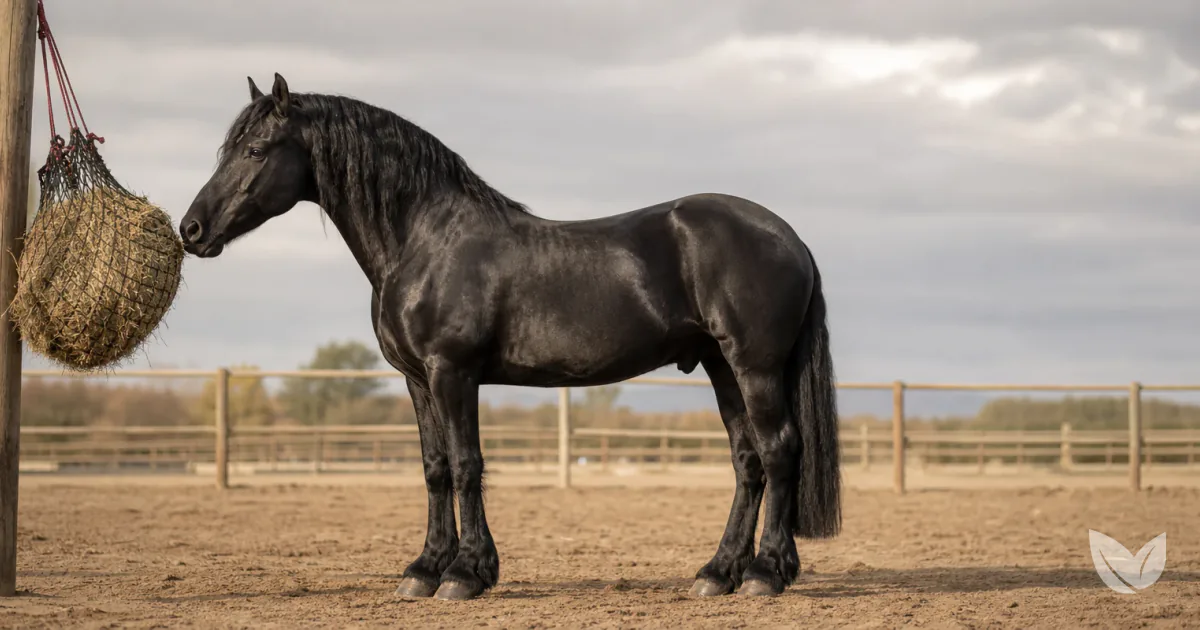
Horses need vitamin A every single day, it keeps their eyesight sharp, bones strong, immune system working, and reproduction on track. Without fresh grass, they can burn through their stores in as little as two months. A 500 kg horse at maintenance needs roughly 15,000 IU daily; working horses need more, and pregnant or lactating mares need double. Fresh green pasture is the safest way to top those levels up, because beta-carotene from grass carries no toxicity risk. Get it badly wrong in the other direction, feeding ten times the recommended amount long-term, and you’re looking at brittle bones, bony growths, skin damage, and birth defects.
Common misconception: Beta-carotene supplements are a safe, equivalent swap for active vitamin A in horses
I get why people go down this road. Beta-carotene is what the horse converts into vitamin A, it has no known toxicity risk unlike retinol or retinyl compounds, and it’s sold as the “natural” option. On the face of it, that sounds like a win.
But the research tells a messier story, and I think the supplement industry is doing horse owners a real disservice by not being straight about it.
The big assumption here is that you can swap a beta-carotene supplement for a retinyl-based one and your horse ends up in the same place, vitamin A-wise. That assumption has actually been tested, directly, in Thoroughbred broodmares. Supplementing at twice the NRC recommended daily intake with retinyl palmitate improved vitamin A status, measured by serum retinol and a relative dose response test. The same amount of water-dispersible beta-carotene? It didn’t move the needle [6, 14]. And separately, synthetic beta-carotene in beadlet form, which is what most commercial supplements use, was found to be ineffective at improving vitamin A status compared to retinyl palmitate [7].
Why does this matter so much in practice? Because horses off pasture can become significantly vitamin A-depleted in as little as two months [9, 17]. Hay stored for longer than a year loses much of its beta-carotene through oxidation [13]. If you’re relying on a beta-carotene supplement to plug that gap, the evidence suggests you may not be plugging it at all.
The NRC’s conversion estimate, roughly 1 mg beta-carotene to 400 IU of active vitamin A [5], with the caveat that horses may actually need more than 10 micrograms of beta-carotene per retinol equivalent [7], may well understate the problem, especially for horses not eating fresh green grass.
Yes, beta-carotene’s lack of toxicity is real, and it matters [5]. But “won’t cause harm” and “will actually work” are two very different things. If a horse genuinely needs vitamin A repletion, the form you choose matters, and right now, the evidence points to retinyl palmitate, not beta-carotene, as the one that does the job.
How Vitamin A works, and where it goes wrong
Vitamin A comes to your horse in two very different forms, and understanding the difference matters.
The first are the *active* forms, retinol and retinyl esters like retinyl palmitate. These are ready to use straight away. The second is beta-carotene, a precursor that the body has to convert before it can do anything with it. Beta-carotene comes from fresh green grass and forage, roughly 1 mg converts to around 400 IU of active vitamin A. The catch is that conversion isn’t always reliable. When Thoroughbred mares were given synthetic beta-carotene in beadlet form, their vitamin A status didn’t improve. Give those same mares retinyl palmitate at twice the NRC daily intake, and it did. So the form your supplement uses isn’t a minor detail, it changes whether anything actually works.
Your horse’s liver is the storage depot for vitamin A. If your horse has had good pasture access for three to four months, the liver typically banks enough to keep plasma levels adequate for another three to six months without supplementation. But lose that pasture access, and stores drop faster than most people realise. In studies using a sensitive test called the relative dose response (RDR) test, mares without pasture access showed significant depletion in just two months. Mares with pasture held on for eight months. Blood vitamin A levels track the seasons too, they run noticeably higher from May to August when fresh grass is available.
One more thing to watch: hay stored for longer than a year. Beta-carotene oxidises during storage, so old hay simply isn’t a dependable source of precursor activity.
Now for the other end of the scale, because vitamin A toxicity is real and it’s serious. The active forms, retinol and retinyl compounds, are fat-soluble, which means the body can’t just excrete the excess. It accumulates in the liver. In pony fillies fed 12,000 micrograms of retinol per kg body weight per day, the animals became debilitated and died within 40 weeks. Even the lower dose group, 1,200 micrograms per kg, showed growth depression. Blood markers of toxicity included reduced serum iron, albumin, and cholesterol. The Merck Veterinary Manual puts the proposed upper safe limit at 16,000 IU of active vitamin A per kg of feed dry matter, and warns that sustained feeding at more than ten times the recommended amount can cause bone fragility, abnormal bone growths, skin lesions, and birth defects. In pregnant mares, excess active vitamin A carries a specific teratogenic risk and has been implicated in developmental orthopaedic disease in growing horses.
Too little, and you’ve got a depleted horse. Too much, and you’ve got a toxic one. Both ends of this scale deserve your attention.
How to get vitamin A right for your horse, amounts, timing, and when to hold back
How much your horse actually needs
Start with the basics: the NRC says horses without access to fresh forage need 30 IU of active vitamin A per kg of body weight per day. For a 500 kg horse, that’s 15,000 IU daily. Pregnant and lactating mares need double, 60 IU per kg per day. Working horses sit somewhere in the middle at around 45 IU per kg per day.
Here’s the thing, though. Those NRC figures have been challenged. Research in pony fillies found that when you look at what the liver and blood actually need to function optimally, the real requirement could be 5.4 times the NRC recommendation, and for red blood cell health, as much as 10 times. The baseline numbers were partly derived from extrapolation rather than direct equine data, and I think it’s fair to say the science has moved on since they were set.
Timing around forage access
Seasonality matters more than most people realise. If your horse gets three to four months of fresh green pasture over summer, their liver will store enough vitamin A to keep plasma levels topped up for another three to six months after the grass goes. Field studies back this up, plasma vitamin A runs significantly higher from May to August when pasture is lush, then tails off.
But deficiency can creep up faster than you’d expect. In broodmares with no pasture access, meaningful vitamin A depletion was detected within just two months. Mares on pasture held on for eight months before the same thing happened. So if your horse is stabled through winter and eating hay rather than fresh grass, you need to be thinking about supplementation sooner rather than later.
One thing people often overlook: beta carotene oxidises as hay ages. Hay stored for more than a year may have very little useful vitamin A activity left in it. If your horse is eating older hay stock through winter, don’t assume it’s covering the requirement, it probably isn’t.
Which form to use
Beta carotene has one big point in its favour: no known toxicity risk in horses. The active retinyl and retinol forms carry real toxicity risk at high doses, so beta carotene looks appealing on paper.
In practice, the conversion is unreliable. The current NRC estimate is that 1 mg of beta carotene converts to around 400 IU of active vitamin A, but research suggests horses may actually need considerably more beta carotene than that to match what retinyl palmitate delivers. A controlled trial in Thoroughbred broodmares found that retinyl palmitate at twice the NRC recommended daily intake improved vitamin A status, while water-dispersible beta-carotene at equivalent levels did not. If you’re dealing with a confirmed deficiency, late pregnancy, or a long period of stabling, active vitamin A forms are simply more reliable.
When to hold back, contraindications
The upper safe concentration is 16,000 IU per kg of feed dry matter. Feeding active retinyl or retinol compounds at more than 10 times the recommended amounts for prolonged periods can cause bone fragility, bony outgrowths, skin lesions, and birth defects. These aren’t theoretical risks, the research in pony fillies showed seriously debilitating outcomes at severely excessive doses.
Pregnancy is the situation where I’d be most cautious. Excess active vitamin A in pregnant mares is specifically linked to birth defects and developmental orthopaedic disease in foals. Excessively high doses are contraindicated in pregnant animals full stop. If the mare has good pasture access, ask yourself whether active supplementation is needed at all.
Likewise, if your horse is on abundant lush pasture or already receiving a fortified concentrate feed at full recommended amounts, pull back on, or suspend, active vitamin A supplementation accordingly.
What we’d recommend
Everyday support for your horse’s joints, immunity, and overall condition.
See the product
Frequently asked questions
How much vitamin A does a horse need per day?
The starting point is 30 IU of active vitamin A per kg of body weight for horses without access to fresh grass, that works out to 15,000 IU a day for a 500 kg horse. Pregnant and lactating mares need twice that (60 IU/kg), and horses in work need around 45 IU/kg. Here’s the thing though: research on weanlings suggests even these figures may be on the low side, with optimal intakes for liver function running at 5.4 times the NRC recommendation.
Can a horse get enough vitamin A from grass and hay alone?
Fresh pasture is the gold standard. A horse grazing good green forage for 3-4 months can build up enough vitamin A in the liver to last a further 3-6 months. The weak link is hay, beta carotene oxidises in storage, and hay that’s been sitting for more than a year may barely supply any usable vitamin A at all. Controlled studies found horses taken off pasture showed measurable depletion within just 2 months.
Is beta carotene a safe alternative to retinol supplements for horses?
Beta carotene has one big advantage: no known toxicity risk in horses, unlike retinol-based supplements. But safety doesn’t mean effectiveness. A Thoroughbred broodmare trial found that water-dispersible beta carotene simply didn’t improve vitamin A status, retinyl palmitate did. Synthetic beta carotene in beadlet form has shown the same problem. Conversion from beta carotene to active vitamin A is variable and often unreliable in horses. Fresh grass is still the best beta carotene source by some margin.
What are the signs of vitamin A toxicity in horses?
Too much active retinol or retinyl over time causes real damage: bone fragility, bony outgrowths, and skin lesions. In the blood, you’d expect to see reduced serum iron, albumin, and cholesterol. A controlled pony study is stark reading, fillies given severely excessive doses became debilitated and died within 40 weeks. This is not a theoretical risk.
Is vitamin A supplementation dangerous for pregnant mares?
It can be. Excess active vitamin A is specifically contraindicated in pregnant mares, high doses are linked to birth defects and developmental orthopedic disease in young horses. This is one of the clearer cases where beta carotene makes more sense than a retinol-based supplement. Horses can regulate how much beta carotene they convert into active vitamin A; preformed retinol bypasses that safety mechanism entirely.
Does vitamin A status change with the seasons?
Markedly. Field data from healthy horses in Canada show plasma vitamin A is significantly higher between May and August, when fresh pasture is available. Broodmare studies using the relative dose response test, a more sensitive measure than a basic serum retinol reading, found that mares off pasture ran through their stores in as little as 2 months. Mares with pasture access lasted 8 months before depletion showed up.
Sources
- Nutritional Requirements of Horses and Other Equids – Management and Nutrition – Merck Veterinary Manual
- Nutritional Requirements of Horses and Other Equids – Management and Nutrition – Merck Veterinary Manual
- Vitamin A nutrition of the equine: growth, serum biochemistry and hematology
- Vitamin A nutrition of the equine: growth, serum biochemistry and hematology
- Nutritional Requirements of Horses and Other Equids – Management and Nutrition – Merck Veterinary Manual
- Vitamin A repletion in thoroughbred mares with retinyl palmitate or beta-carotene
- Meeting the Vitamin A Requirement: The Efficacy and Importance of β-Carotene in Animal Species
- Seasonal vitamin A depletion in grazing horses is assessed better by the relative dose response test than by serum retinol concentration
- The vitamin A and vitamin E status of horses raised in Alberta and Saskatchewan
- Nutritional Requirements of Horses and Other Equids – Management and Nutrition – Merck Veterinary Manual
- Vitamin A nutrition of the equine: growth, serum biochemistry and hematology – PubMed
- Nutritional Requirements of Horses and Other Equids – Management and Nutrition – Merck Veterinary Manual
- Vitamin A repletion in thoroughbred mares with retinyl palmitate or beta-carotene – PubMed
- Nutritional Diseases of Horses and Other Equids – Management and Nutrition – Merck Veterinary Manual
- Seasonal vitamin A depletion in grazing horses is assessed better by the relative dose response test than by serum retinol concentration – PubMed