Active horses · Oct 15, 2016
Here is how to improve your horse’s topline in 8 weeks
Without the correct balance of limiting amino acids and targeted movement, even a well-fed, well-ridden horse will struggle to build and hold back muscle.
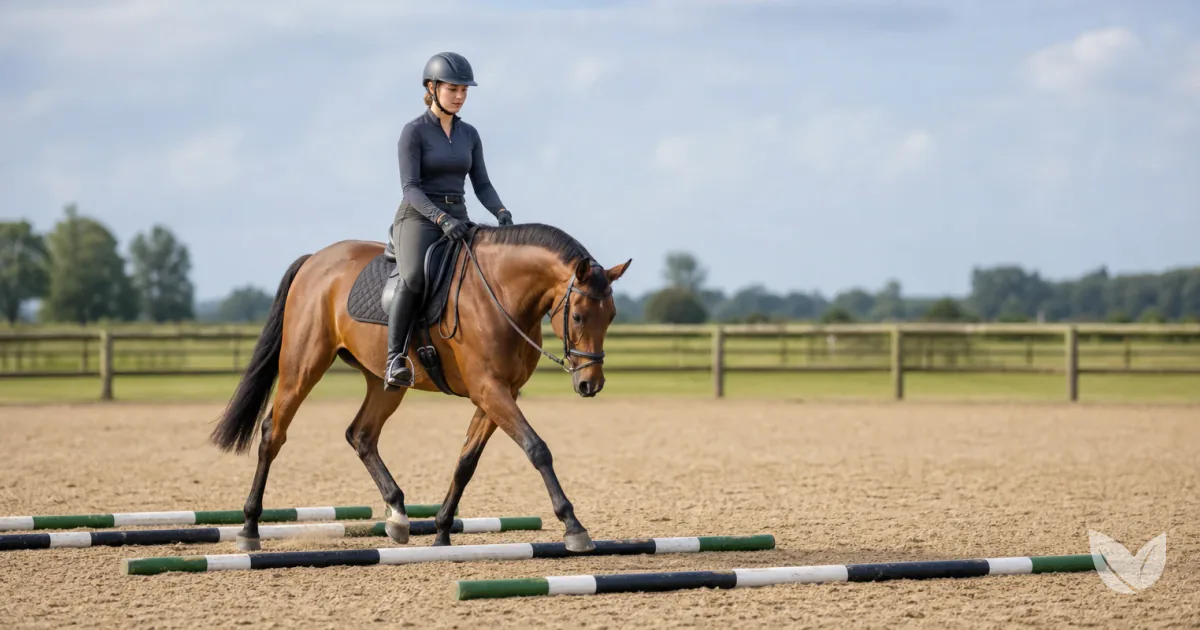
Building topline in horses requires both targeted exercise and quality protein nutrition working together. The topline muscles, including the longissimus dorsi, multifidus, and cervical extensors, support the vertebral column against the compressive forces of rider weight and movement, so weakness here is a genuine soundness issue. Equine skeletal muscle is highly plastic and responds to progressive training, but muscle protein synthesis depends on adequate supply of the limiting amino acids lysine, threonine, and methionine, not just total protein intake. Without both stimulus and substrate, you will not build the muscle you are looking for.
Practically, here is how to improve your horse’s topline
Your horse’s spine is designed like a bridge. The vertebrae are strung together and supported by muscles, similar to the design of a suspension bridge. When the additional weight of a rider is added, the spine is supported by the back muscles and the abdominal muscles. If these are weak, the danger increases of the vertebrae sagging and leading to further problems. When we speak of building topline in horses, we are speaking of developing all of these muscles.
Topline in horses actually consists of all the muscles along the neck,topline in horseswithers, back, loin and hindquarters of the horse (gluteal, dorsal and cervical extensor muscles). The topline should be rounded and strong, not sunken in in any way.
When your horse moves, he should appear relaxed and be able to coil his loin muscles, raise the base of his neck and move freely and powerfully forward. Strengthening the topline will make this easier for him and healthier for the spine.
What does a weak back look like?
A horse with a weak back will probably not ‘track up’ as much as he should. The hind foot should step, at the very least, into the footprint left by the front foot.
Seen from behind, a weak backed horse will often walk with its left and right hooves too close together, as if walking on a tightrope.
He might also tend to ‘pace’, where the two left legs move forward together, followed by the two right legs. A good walk has a rhythmic 1-2-3-4 beat.
He will also, because of all the above, lack impulsion and straightness.
Visually, you might notice some or all of the following to varying extents:
the neck is concave and hollow
either side of the withers is sunken
vertebrae are higher than the surrounding muscle
the hip bones are pointy and the muscle surrounding them sunken
the width of the stifles is much narrower than the width of the hips
After ruling out disease as a possible cause of lack of topline in horses, it really comes down to two ways to improve it – diet or exercise. With this plan, we address both of these.
Lifestyle
In order to make build topline in horses quickly and effectively, you might need to make a few lifestyle changes.
A horse standing in a stable has an idle topline. It is far better if he can be turned out, at least for a few hours every day. Walking around, grazing, playing with his friends will all be beneficial.
If you can, stop using haynets or elevated hay racks. Horses should be eating their hay at ground level.
Make sure that you, the rider, are fit and balanced. If you are uneven in your seat or flopping around in the saddle, your horse won’t be able to use his back well.
Ensure that your saddle fits correctly. A poorly fitting saddle can cause huge problems.
Make sure that your horse’s feet are healthy, strong and in good condition. Moving cautiously because of foot pain can cause loss of muscle tone in the back.
Diet
Muscles are made from protein. So, if you want to be building topline in horses, you need to provide adequate protein in the diet. An average horse in average work needs 630 to 900 g of protein per day. Forget about the % protein on the horse food label – you need to work out the actual gram amount. Factor in the protein content of your grazing and hay as well as any supplements. (Email me on beryl@theherbalhorse.com if you need help working it out.)
Then, in addition to the total amount of protein, you need to think about protein quality as well.
In your horse’s body the proteins for muscles are manufactured using a process called protein synthesis. Specific proteins are manufactured, with the help of RNA, by adding amino acids in a specific sequence. (Amino acids are smaller, nitrogen containing molecules which are the building blocks of proteins.)
A big problem arises when a specific amino acid is required and is not available. Essential amino acids are amino acids which cannot be synthesised by the horses body and therefore HAVE to be present in his diet. If the amino acid required by the RNA is not present during protein synthesis, the entire process stops. Which means that that muscle doesn’t get developed. The most ‘limiting’ amino acids are Lysine, Methionine and Threonine. This means they are the amino acids which most often shut down protein synthesis because they are absent.
So it makes sense to add a supplement which contains all of the essential amino acids, especially the limiting ones.
Exercise Program
For the purposes of this programme to build topline in horses, we will assume that the horse in question has been in light work for a few weeks at least and that the rider now wants to get him show ready, fit and (of course) develop his topline. Adjust this programme to suit yourself and your horse, it is simply a guide.
Week 1
Start off by hacking out at a walk on a long rein for about an hour a day. Allow the horse to completely relax, mentally and physically. Encourage him to lower his head and stretch his neck. (This stretches all the muscles along the back.) Walk up and down hills. Don’t slop along – walk forward with a loose swinging stride.
Week 2
Start to introduce trotting in the same loose, free forward way on a long rein. Don’t worry if his head is at knee level, that is where you want it. Do quite a bit of trotting on a long rein up hills. Again, the horse must engage and move forward with energy and purpose.
Week 3
In week 3, introduce canter work, on a long rein out on hacks. Keep it slow and loose and include quite a few hills. If there is safe knee-deep water along your hack, trot through it. Trotting through water causes the horse to lift his belly using his back muscles.
Week 4
You can now introduce work in the school. Keep the long rein, encourage your horse to stretch his neck down. Do large circles, big loops, changes of direction. After warming up long and low, start to pick the reins up and ask for more collection. Do transitions between walk, trot and canter and also within the gait – slow, medium, fast. Ask for short extensions. Use half-halts to encourage self-carriage. Do some easy lateral work where you encourage the horse to step under with the hind legs, engaging the topline muscles. Keep a couple of days a week for hacking as per the previous few weeks.
Week 5 to 8
At this stage, it would be very advantageous to introduce Visconte Simon Cocozza’s system of Core Correction exercises into your schooling routine. This is basically yoga for horses and helps to strengthen the back, specifically helping to prevent back pain and problems such as kissing spine. They can be found in more detail here: http://www.bevet.com/files/introductiontocorecorrection.pdf
This is a summary of these exercises:
Inside ‘Half Moon’ bend and stretch
A small circle around a cone with a long rein and a lot of inside bend.
Leg yield ‘Triangle’ stretch in walk
Leg yield on a long rein with a low head and a lot of inside bend.
¼ to full turn about the forehand – The ‘Half Split’
Turn on the forehand. When the horse easily drops the inside rein to you and willingly gives the outside rein a contact, the correction has been made.
¼ to ½ Pirouette – Turn about the haunches to ‘Thread the Needle’
Turn on the haunches from a standstill, bending to the inside with an open rein.
Top tips from Simon:
Long and low will stretch the horse but when you have an improvement, do the exercise at least once ‘on the bit’.
Try to keep your weight in the saddle and stirrups always even sided whatever is going on.
If you can’t sit to the trot or canter, don’t. Use the exercises to get more spinal freedom and then try later when the gait feels smoother.
When bending the horse never pull the rein, only ever hold steady at the angle you want and wait till the horse gives to the rein in response to the leg. When he wants to drop his head and stretch out, let him.
You and your horse need to understand each other very well in order to bond and become one. If you feel that you can do a bit more, try it and let your horse be your guide.
A core score 0 horse (a horse with very low danger of spinal problems) will walk, trot and canter in balance with his nose very near the sand the moment you fully give the reins. This is your goal.
What we’d recommend
Amino acids plus other topline building ingredients
See the product
Frequently asked questions
How much rider weight is too much for a horse’s back?
Biomechanical research shows measurable changes in gait and increased lumbosacral flexion once rider weight exceeds 20-25% of the horse’s body weight. Under heavier loads the thoracolumbar spine hollows proportionally, think of a loaded bookshelf sagging in the middle. This is precisely why strong topline musculature matters: it is the primary defence against that compressive loading.
What are the most important amino acids for building topline in horses?
Lysine, threonine, and methionine are the limiting amino acids, the ones most likely to be absent when you need them, which halts muscle protein synthesis entirely. Research shows that balanced supplementation of these three amino acids produces greater type II muscle fibre area in exercising horses even when total protein intake is identical to a standard diet, meaning amino acid ratio matters as much as total grams.
Can a horse build topline on forage alone without supplements?
Forage should form at least 50% of the diet and is the foundation, but most forages are deficient in one or more limiting amino acids. Current NRC guidelines only define lysine requirements for horses, leaving other essential amino acids poorly characterised. For horses in regular work, particularly if feed volumes are not increased to match energy demands, a targeted amino acid supplement is often necessary to support muscle protein accretion.
Does head and neck position during exercise affect which topline muscles are trained?
Significantly, yes. Training in a collected frame with the nose slightly in front of the vertical activates the splenius and trapezius, the upper topline muscles, most effectively. Hyperflexion with the nose behind the vertical shifts the stimulus to the brachiocephalicus, a lower topline muscle. Working long and low, which stretches the back, is therefore a different training stimulus from collected work, and both have a role in a balanced programme.
Why should horses eat hay at ground level rather than from a haynet?
Eating from ground level encourages thoracolumbar spine flexion and optimal intervertebral spacing. Sustained feeding from elevated haynets creates prolonged spinal extension, which research associates with lordotic posture, over-riding dorsal spinous processes, osteoarthritis, and muscular pain. It is one of the simplest management changes you can make and costs nothing.
Do deep spinal muscles like the multifidus respond to targeted exercise?
They do, and the evidence is compelling. A 12-week dynamic mobilisation programme produced significant increases in multifidus cross-sectional area at five vertebral levels (T10 to L5), and the muscle became more symmetrical on left and right sides. These deep stabilisers are structurally different from the superficial longissimus, they require specific activation patterns, not just general riding, to develop effectively.
Sources
- Muscle Fibre Architecture of Thoracic and Lumbar Longissimus Dorsi Muscle in the Horse
- Riders' Effects on Horses—Biomechanical Principles with Examples from the Literature
- The effect of three different head-neck positions on the average EMG activity of three important neck muscles in the horse
- Amino acid requirements in horses
- Effect of balanced vs. standard protein on muscle mass development in exercising horses
- The effect of supplemental lysine and threonine on growth and development of yearling horses
- Amino acid supplementation improves muscle mass in aged and young horses
- The Effect of a Physiotherapy Intervention on Thoracolumbar Posture in Horses
- Gross anatomy of the deep perivertebral musculature in horses
- Equine skeletal muscle adaptations to exercise and training: evidence of differential regulation of autophagosomal and mitochondrial components
- Equine Rehabilitation: A Scoping Review of the Literature
- Nutritional Requirements of Horses and Other Equids – Merck Veterinary Manual
- Effect of balanced vs. standard protein on muscle mass development in exercising horses
- Differential effect of two dietary protein sources on time course response of muscle anabolic signaling pathways in normal and insulin dysregulated horses
- Gross anatomy of the deep perivertebral musculature in horses
- How to feed an equine athlete – American Veterinary Medical Association
- Horse Husbandry–Nutrition, Management and Welfare
- Amino acid requirements in horses