For horses · Dec 21, 2012
Devil’s claw is a credible alternative to bute, with one important catch
The evidence for Harpagophytum procumbens as an analgesic and anti-inflammatory for horses is solid, but its competition status and whole-extract dependency mean you need to use it correctly.
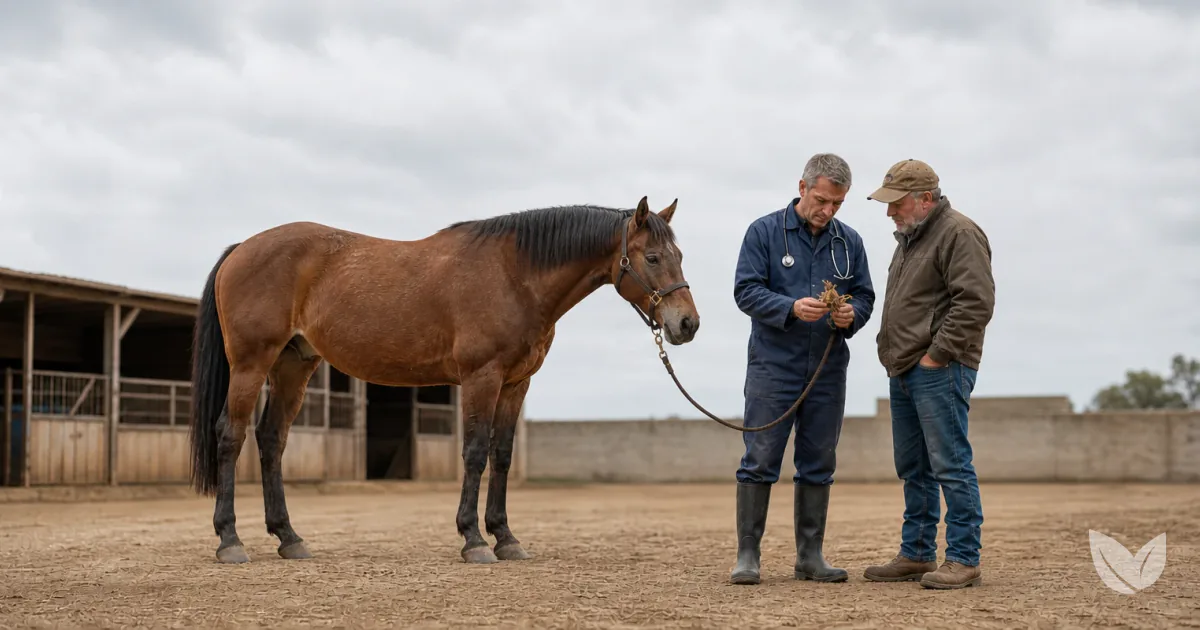
Devil’s claw (Harpagophytum procumbens) is an effective natural anti-inflammatory and analgesic for horses, with clinical and preclinical data confirming it suppresses COX and lipoxygenase pathways, inhibits pro-inflammatory cytokines, and improves locomotor scores in horses with osteoarthritis. The whole extract drives these effects, isolated harpagoside alone shows little anti-inflammatory activity. Harpagoside is detectable in equine plasma for up to nine hours after oral dosing, and harpagoside is a prohibited substance under FEI rules, with no published detection time.
Harpagoside is the single active ingredient in Devil’s Claw
It’s an understandable assumption. Harpagoside is the compound used as the reference standard for extract quality, it’s the one named on labels, and it’s the one the FEI put on its Prohibited Substance List. So the industry, and plenty of researchers, defaulted to treating it as the active ingredient. The problem is, that’s not what the evidence shows.
When harpagoside has been tested in isolation, it shows little to no anti-inflammatory effect. The full Devil’s Claw (Harpagophytum procumbens) extract, by contrast, does, and the difference comes down to the plant’s broader chemistry. The root contains a whole suite of compounds alongside harpagoside: fellow iridoid glycosides harpagide and procumbide, phenolic glycosides, flavonoids, triterpenes, phytosterols, and aromatic acids. The anti-inflammatory action appears to work through inhibition of both the cyclooxygenase (COX) and lipoxygenase arms of the arachidonic acid cascade, plus suppression of cytokine release, a multi-pathway effect that isolated harpagoside simply cannot replicate on its own.
This matters practically. It means standardising a product purely on harpagoside content, while ignoring the rest of the extract profile, may not tell you much about how well it will actually work. If you’re buying Devil’s Claw for a horse with joint pain, the quality and completeness of the whole extract is the thing to interrogate, not just the harpagoside percentage on the label.
How devil’s claw works on inflammation and pain
Devil’s claw (Harpagophytum procumbens) contains a family of active compounds, principally the iridoid glycosides harpagoside, harpagide, and procumbide, alongside phenolic glycosides, triterpenes, phytosterols, and flavonoids. Harpagoside is considered the primary marker of therapeutic activity and is used as the reference standard for extract quality.
The anti-inflammatory action works through at least two well-documented routes. First, harpagoside interferes with the arachidonic acid cascade at both the cyclooxygenase (COX) and lipoxygenase branches, the same enzymatic pathways that conventional NSAIDs target. Second, the extract suppresses the release of pro-inflammatory cytokines: in macrophage cell studies, devil’s claw extract produced dose-dependent reductions in IL-1β, IL-6, and TNF-α following a lipopolysaccharide challenge, with harpagoside identified as one of the contributing agents within the extract.
The finding that still puzzles researchers: isolated harpagoside alone produces little anti-inflammatory effect when tested in isolation. The full activity appears to depend on the whole extract, suggesting the other constituents play a meaningful supporting role, though precisely how they interact is not yet established.
In horses, oral pharmacokinetic work shows that harpagoside is detectable in plasma within one hour of intragastric administration and remains detectable for up to nine hours, with a proportional dose-response relationship. No clinically detectable gastrointestinal side effects were observed in those study animals.
Using Devil’s Claw in horses: what the evidence actually supports
Absorption and timing
Pharmacokinetic work in horses shows that harpagoside is detectable in plasma within 1 hour of oral intragastric administration and remains detectable for up to 9 hours. The dose-response relationship is proportional, meaning higher doses produce correspondingly higher plasma concentrations. That 1-hour peak matters practically: if you are timing administration around exercise or a veterinary assessment, oral dosing several hours beforehand gives the compound time to be absorbed and circulating.
What the comparative horse study used
The one comparative study in horses with tarsal osteoarthritis used a herbal preparation containing Harpagophytum at 20 g total, administered 10 days per month, and found significant improvement in locomotor scores versus daily phenylbutazone at 2 g. I flag that study’s limitations honestly – small sample, no blinding, subjective assessment and arbitrary dose point – so treat those figures as a reference point rather than a definitive clinical dose.
Oral safety profile
In the pharmacokinetic horse study, treatment with Harpagophytum extract caused no clinically detectable side effects, including no gastrointestinal irritation. The broader human safety literature, covering over 20 years of clinical studies, records infrequent adverse events, primarily gastrointestinal disturbances (diarrhoea, nausea, vomiting, abdominal pain), headache, vertigo, and hypersensitivity reactions, at a rate no higher than placebo. That is a reassuring profile relative to phenylbutazone, which at standard equine doses (4.4 mg/kg, twice daily) causes gastric ulceration in 60% of horses, a 3-fold increase in bacterial translocation, and measurable mucosal necrosis within 24 hours.
Competition rules, this is non-negotiable
Harpagoside is on the FEI Prohibited Substance List as a controlled medication and is prohibited during training and competition. Critically, the FEI has not published a detection time for harpagoside, which means there is no official guidance on when to stop use before a event. Until the FEI publishes detection times, the only safe position for competition horses is to consult your governing body and, where in doubt, withdraw the supplement well in advance.
What we’d recommend
Reduces pain and inflammation without the gastric damage caused by phenylbutazone or other NSAIDs.
See the product
Frequently asked questions
How does devil’s claw reduce inflammation in horses?
Harpagoside, the primary active iridoid glycoside in Harpagophytum procumbens, inhibits inflammation by interfering with both the cyclooxygenase (COX) and lipoxygenase arms of the arachidonic acid cascade, and by suppressing cytokine release (including IL-1β, IL-6, and TNF-α). Crucially, isolated harpagoside alone produces little anti-inflammatory effect; the full extract is needed. This means whole-plant extract quality matters enormously, and I’d be sceptical of any product standardised only to a single isolated compound.
Is devil’s claw safe for horses to take long-term?
The pharmacokinetic study in horses found no clinically detectable side effects, including no gastrointestinal irritation, after oral administration of Harpagophytum extract. Over twenty years of clinical data in humans similarly shows that adverse event rates during devil’s claw treatment are no higher than during placebo. Occasional gastrointestinal disturbances (diarrhoea, nausea) have been documented, but infrequently. Compare that with phenylbutazone, which caused significant gastric ulceration in 60% of horses at standard doses.
Why choose devil’s claw over phenylbutazone (bute) for a horse with joint pain?
Phenylbutazone at standard equine doses (4.4 mg/kg twice daily) caused significant gastric ulceration in 60% of horses tested, increased bacterial translocation more than threefold, and disrupted beneficial gut microbiota. Early studies also showed it induces pyloric erosions within 24 hours of use. Devil’s Claw, by contrast, carries no equivalent gastric risk in the available evidence. For horses already prone to ulcers, the safety profile of a well-made Harpagophytum extract is a serious clinical consideration.
How quickly is devil’s claw absorbed after oral dosing in horses?
In a pharmacokinetic study, harpagoside was detectable in equine plasma within the first hour of oral intragastric administration, reaching maximum plasma concentration at approximately 1 hour and remaining detectable for up to 9 hours. The dose-response relationship was proportional, meaning higher doses produced correspondingly higher plasma levels. This gives reasonable confidence that orally administered extract does reach systemic circulation at meaningful concentrations.
Is devil’s claw banned in equestrian competition?
Yes. Harpagoside is included on the FEI (Fédération Équestre Internationale) Equine Prohibited Substance List as a controlled medication, banned during training and competition. However, and this is important, harpagoside does not appear on the FEI’s List of Detection Times, which leaves horse owners without clear guidance on when to stop supplementing before a tournament. Until detection times are formally published, I would err on the side of a generous withdrawal period (3 to 7 days) and cheque with your governing body directly.
Does devil’s claw actually work for horses with osteoarthritis, or is the evidence weak?
A comparative study in horses with tarsal osteoarthritis found that locomotor scores improved significantly with a herbal treatment containing Harpagophytum (20 g total, given 10 days per month) versus daily phenylbutazone (2 g). I won’t overstate it, the study was small, unblinded, and used subjective assessment, so its reliability is limited. The broader preclinical data on anti-inflammatory and analgesic mechanisms is solid, and clinical trial data in humans is encouraging, but equine-specific clinical trials remain thin.
Sources
- Pharmacokinetics of harpagoside in horses after intragastric administration of a Devil's claw (Harpagophytum procumbens) extract – PMC
- Systemic Hypertension Induced by Harpagophytum procumbens (devil's claw): A Case Report – PMC
- Pharmacokinetics of harpagoside in horses after intragastric administration of a Devil's claw (Harpagophytum procumbens) extract
- Effects of phenylbutazone alone or in combination with a nutritional therapeutic on gastric ulcers, intestinal permeability, and fecal microbiota in horses – PMC
- The effects of phenylbutazone on the morphology and prostaglandin concentrations of the pyloric mucosa of the equine stomach – PubMed
- Devil's claw (Harpagophytum procumbens) and chronic inflammatory diseases: A concise overview on preclinical and clinical data – PubMed
- Toxicology studies of aqueous-alcohol extracts of Harpagophytum procumbens subsp. procumbens in female and male rats – PMC
- From Bush Medicine to Modern Phytopharmaceutical: A Bibliographic Review of Devil's Claw (Harpagophytum spp.) – PMC
- From Bush Medicine to Modern Phytopharmaceutical: A Bibliographic Review of Devil's Claw (Harpagophytum spp.) – PMC
- Inhibitory effects of devil's claw (secondary root of Harpagophytum procumbens) extract and harpagoside on cytokine production in mouse macrophages – PubMed